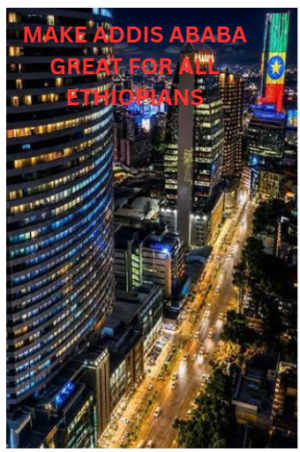
MEMORANDUM TO HISTORY AND POSTERITY: Why I Am Setting the Record Straight
I have written this rather lengthy commentary because I believe I have a moral obligation to stand up and speak out against the lies, distortions and disinformation that have been circulating on social media and elsewhere about the work of the Federal Cities Agenda Group on the so-called Addis Ababa status/question during the Ethiopian National Dialogue Conference. Dr. Martin Luther King, Jr. cautioned, “Our lives begin to end the day we become silent about things that matter.”
Much of what is now being circulated about the “status and question of Addis Ababa,” what was supposedly “decided,” and what was allegedly “recommended” by the Federal Cities Agenda Group is simply false. Some of it is based on misunderstanding. Some of it is selective and misleading. Some of it half-truths. But much of it is deliberate fabrication—designed not to inform Ethiopians, but to inflame passions, deepen suspicion and turn Addis Ababa once again into a battleground for ethnic and political confrontation.
I know this because I was there. I served as a delegate on the Federal Cities Agenda Group. For forty days, I participated in the meetings, deliberations, debates and discussions that produced the consensus recommendations. I discussed. I argued. I took notes. I mostly listened to get a deeper understanding of what and why my co-delegates are saying and not saying. For forty nights, I extensively documented and chronicled the proceedings of the National Dialogue Conference, all of them publicly available on my X (formerly Twitter) account; Google for @almariam1.
I do not claim that every delegate agreed on every issue. Far from it. But there was scarcely an issue—however sensitive, controversial, insignificant or extreme—that was not raised and discussed about Addis Ababa in our Agenda Group. Delegates came to the Conference with profoundly different experiences, convictions, and political agendas and perspectives. They argued passionately for their positions. At times, the disagreements were sharp. But the remarkable fact is that they debated one another with civility and respect. They listened even when they disagreed. They argued without being disagreeable or treating disagreement as enmity.
That is the historical fact. And that fact matters. The debates and disagreements were important. They revealed the depth and complexity of the questions confronting Ethiopia. But ultimately, the most important product of the process was not the disagreement. It was the 99.75 percent consensus that emerged from it. That consensus was not imposed by one group upon another. It was not the victory of one ethnicity over another, one political ideology over another, or one historical narrative over another. It was the result of Ethiopians with sharply differing views sitting together, speaking openly, disagreeing honestly and searching for common ground. The consensus was inclusive, not divisive. That is precisely why the current campaign of lies and distortions about the “Addis Ababa question” is so repulsive.
There are merchants of division and polarization who thrive on conflict. They see every national question through the narrow prism of ethnic power and political domination. They are now working overtime and in overdrive to misrepresent the work of the Federal Cities Agenda Group and to turn Addis Ababa into a symbol and battleground of ethnic confrontation.
Their objective is not dialogue. It is polarization. Their interest is not in understanding what was actually discussed, debated and agreed upon. Their interest is in manufacturing outrage, spreading fear and convincing Ethiopians that coexistence is impossible unless one group triumphs over another.
That is precisely the mentality the National Dialogue Conference sought to transcend. The work of the Federal Cities Agenda Group was not to hand Addis Ababa to one group or take it away from another. It was not to erase history, deny identity or name winners and losers. Our task was far more difficult and far more important: to confront competing claims honestly and to search for a solution capable of recognizing legitimate interests while protecting the dignity, rights and belonging of all.
We sought the middle road—not as an escape from principle, but as the highest expression of political wisdom. We sought the golden mean: a principled and practical path capable of holding together truths that extremists on all sides insist must be mutually exclusive.
The future of Addis Ababa cannot be secured by ethnic monopoly. Nor can it be secured by denying history, identity or legitimate grievances.
Peace cannot be built on exclusion, and unity cannot be imposed by erasure. The challenge before Ethiopia is to create a political and constitutional order capable of respecting Oromo identity and legitimate interests while ensuring that every Ethiopian, regardless of ethnicity, language, religion or political belief, enjoys equal dignity, equal citizenship and a genuine sense of belonging.
That was the spirit in which the Federal Cities Agenda Group worked. That is the record that must be preserved.
History is not merely what happened. History is also what is recorded, remembered, transmitted and ultimately believed by future generations. If lies are repeated often enough, if distortions are allowed to circulate without challenge, and if those who witnessed events remain silent, falsehood can harden into accepted history.
That is why silence is not always neutrality. Sometimes silence becomes complicity in the destruction of the historical record. Those of us who were present have a particular responsibility. We may disagree about the meaning of events. We may offer different interpretations. But we should not permit demonstrable falsehoods to replace the facts of what actually occurred. That is why I stayed late into the wee hours, fighting sleep to stay awake, every night of the Conference, to write and document the proceedings of the day and post them on X @almariam1 .
Future generations deserve better. They deserve an accurate record of what Ethiopians did when they were given the opportunity to sit together and confront some of the most difficult questions in their country’s history. They deserve to know not only what divided us, but also what we were able to agree upon. They deserve to know that Ethiopians with profoundly different views were capable of talking to one another. They deserve to know that disagreement did not inevitably lead to verbal confrontation or physical violence. They deserve to know that passionate debate did not prevent consensus. And they deserve to know that, even on one of the most emotionally charged and politically sensitive questions in Ethiopia—the question of Addis Ababa—Ethiopians searched for a path beyond the politics of winners and losers.
I therefore write not to claim ownership of the truth or to silence criticism. Every Ethiopian has the right to disagree with the recommendations of the Federal Cities Agenda Group. Every Ethiopian has the right to criticize the National Dialogue process. Every Ethiopian has the right to advocate for a different solution.
But no one has the right to invent facts. No one has the right to put words in the mouths of delegates. No one has the right to fabricate decisions that were never made, conceal the consensus that was actually reached, or deliberately spread falsehoods in order to incite ethnic hostility and political confrontation.
Criticism is legitimate. Disagreement is legitimate. Debate is essential.
But lies are lies. Distortion is distortion. Disinformation is disinformation.
And when falsehood is deliberately used to divide a people already burdened by conflict, mistrust and historical grievance, those who know the truth have a responsibility to speak.
I have that heavy moral responsibility!
That is why I am setting the record straight. I do so as a delegate who participated in the process, as an observer who documented its proceedings, as a panel expert who gave learned opinions on law and policy, and as an Ethiopian — and poignantly as the lost prodigal son who returned home after more than one half century in the diaspora– who believes that our country has already paid far too high a price for lies, manipulation, hatred and the deliberate distortion of one another’s history and intentions. The prodigal son who believes Ethiopians can put their collective shoulders to the wheel and noses to the grindstone and MAKE ETHIOPIA GREAT AGAIN.
I am accountable to my contemporaries, but I also believe I am accountable to history and to generations yet unborn.
Years from now, people may look back and ask: What actually happened at the Ethiopian National Dialogue Conference? What did the delegates discuss? What did the delegates on the “Federal Cities Agenda Group” discuss, agreed and disagreed about? What did they finally agree upon? And when falsehoods began to circulate, did those who knew the facts remain silent?
I want the historical record to show that at least some of us defiantly refused to remain silent. I want future generations to have access to the facts so that they may judge the process for themselves.
They may accept the conclusions and recommendations we crafted at the Conference, or reject them. They may improve upon them or replace them with better ideas. That is their right. But they should not have to build their understanding of this historic moment on lies.
The truth does not need to be protected by propaganda. It needs only to be accurately recorded, honestly told and courageously defended.
That is my purpose in writing this commentary.
I was there. I participated. I listened. I debated. I documented. And because I believe I owe a duty to truth, to history and to future generations, I will not allow lies and distortions about the work of the Federal Cities Agenda Group to go unanswered.
I therefore set the record straight—not to reopen old divisions, but to prevent falsehood from creating new ones; not to inflame passions, but to replace rumor with fact; and not to claim the last word, but to ensure that the truth has its rightful place in the historical record.
I STAND TO SET SET THE RECORD STRAIGHT!
Let others set their own records.
=====================================================================================
PRESENT AT THE DIALOGUE TABLE: I MUST SPEAK UP AND SET THE RECORD STRAIGHT!
The old saying is true, “Those who know don’t talk; those who talk do not know.”
Those who are ignorant about the proceedings of the Ethiopian Dialogue Conference on the “Federal Cities Agenda” speak recklessly and protest too much to compensate for their lack of first hand knowledge and critical understanding of the Conference proceedings and recommendations.
I was present at the Conference and directly participated in the “Federal Cities Agenda” discussions on the “status of Addis Ababa.” I must speak up to set the record straight!
During the 40-day Ethiopian National Dialogue Conference, I was randomly assigned — as was the procedure for all agenda groups — to serve as a delegate on the “Federal Cities Agenda Group.” In addition, I had the special privilege of serving on the “panel of experts” and provided delegates across agenda groups technical consultation and learned opinion on a range of constitutional, legal and policy issues.
I was also elected to serve on the “Kilil Representatives Group,” established to address issues that had produced stalemates or deadlocks. I had special access to observe the deliberations of all agenda groups. Based on these experiences and observations, I provided uninterrupted and detailed daily chronicles and updates on the Conference proceedings through my X (formerly Twitter) [ Google @almariam1 ] page.
After 40 days of intensive deliberations, nearly 4,000 delegates from across Ethiopia—except from a few areas where security conditions prevented participation—produced approximately 400 recommendations and reached an extraordinary 99.75 percent consensus across all Conference agendas.
That is an epic and monumental achievement for Ethiopia and Africa. Indeed, it is one small step for dialogue in Ethiopia and one giant leap for peace and reconciliation in Africa and the world.
“ADDIS ABABA QUESTION”?
Following the conclusion of the Conference, the nattering nabobs of negativism began to blow the “question of the status of Addis Ababa” out of all proportion, manufacturing and spreading malicious lies and divisive disinformation on social media. Their sinister aim was to exploit the “Addis Ababa question” as a wedge issue—to divide Ethiopians, distract global attention from the monumental achievements of the National Dialogue Conference and undermine public confidence in dialogue as a new and peaceful modality for resolving Ethiopia’s most difficult national disputes.
I will not dignify such disinformation by repeating it, nor will venture to give a patina of credibility to fabricated falsehood as legitimate debate.
But having participated directly in the “Addis Ababa status” discussions and deliberations and armed with personal and intimate knowledge of the Conference process, I believe I have a moral responsibility to set the record straight.
MY STAND AGAINST THE POLITICIZATION AND WEAPONIZATION OF ADDIS ABABA
My position is crystal clear: I categorically reject any attempt to politicize Addis Ababa and turn it into a wedge for dividing Ethiopians against one another. Equally, I resolutely denounce every effort undertaken to diminish or overshadow the epic and historic achievement of nearly 4,000 Ethiopians who came together, sat across from one another, debated their differences with extraordinary civility, and reached an unprecedented level of consensus, 99.75 percent consensus on all agenda issues!
I will not allow this remarkable national achievement — indeed spectacular achievement for humankind —to be dishonored and disparaged by the wicked mendacity of professional social media crybabies and their cantankerous counterparts at home, who would rather exploit differences, manufacture outrage and sow suspicion than acknowledge a moment of genuine national progress.
I know exactly what they are trying to do with the so-called Addis Ababa question: Drag Ethiopia back into the destructive politics of division, polarization and perpetual conflict. They will not succeed because Ethiopia has taken a decisive and irreversible step toward DIALOGUE, and we must never allow the merchants of division and death to turn the clock back on us.
The National Dialogue Conference has demonstrated to the world that Ethiopians can disagree without being disagreeable and enemies. They can confront difficult historical and political questions without resorting to violence, and seek common ground without requiring anyone to surrender their dignity. They have proven to the world they are determined to MAKE ETHIOPIA GREAT AGAIN.
For years, all stripes of political actors have attempted to transform Addis Ababa from what it fundamentally is—a great Ethiopian city, a federal capital, the diplomatic capital of Africa, global diplomatic hub and a home to millions of people from every part of the country—into an instrument for dividing and polarizing Ethiopians.
Politicization and weaponization of Addis Ababa must stop. NOW!
The Ethiopian National Dialogue Conference was designed to provide a forum to bring difficult questions out of the arena of political confrontation and into a process of reasoned discussion, mutual recognition and peaceful compromise. Reasoned discussion is exactly what we did when we addressed the issue of the “status/question of Addis Ababa.”
I speak confidently on behalf for my “Federal Cities Agenda Group of 500” when I say that each one of us was guided by one primordial principle: No Ethiopian should be treated as a stranger in Addis Ababa simply because of his or her ethnicity, language, religion or region of origin. We all started with the rock-solid belief that Addis Ababa is home to Ethiopians from every corner of the country. Generations of Ethiopians have come to the city to work, study, build businesses, serve in government and raise families. It is also the federal capital, Africa’s diplomatic capital, global diplomatic hub and the seat of national institutions and a city whose economic, political and cultural life has been shaped by the contributions of Ethiopians from every community. To reduce Addis Ababa to the exclusive possession of any one ethnic group or political constituency is neither a solution nor a path to peace. It is absurd. It is a dangerous illusion—and an insult to the intelligence, goodwill, shared history and patriotism of all Ethiopians.
Addis belongs neither to those who seek to monopolize it nor to those who would weaponize its identity. Its future must be built on inclusion, equal citizenship and the recognition that Ethiopia’s capital is a shared national home.
Recognizing Addis Ababa as a city belonging to all Ethiopians does not require ignoring its history, its geographical location or the legitimate interests and concerns of the Oromo people and the Oromia Regional State. The current Constitution under Article 49.5 provides:
The special interest of the State of Oromia in Addis Ababa, regarding the provision of social services or the utilization of natural resources and other similar matters, as well as joint administrative matters arising from the location of Addis Ababa within the State of Oromia, shall be respected. Particulars shall be determined by law.
This provision acknowledges that Addis Ababa is geographically located within the Regional State (“Kilil”) of Oromia with “special interest” that shall be determined by law. These interests include, among others, social services to Oromo residents, utilization of natural resources from the city, joint administrative matters arising from the city’s location within Oromia. The specific legal framework to implement these special interests has been debated for decades without any meaningful legislative or policy action.
During our discussions and deliberations in the Federal Cities Agenda Group, every conceivable issue related to the status of Addis Ababa was brought up and discussed. The diverse views and proposals expressed by delegates have been registered with maximum transparency in meticulous detail in the discussion minutes and preserved in raw video footage. Not a single view, however insignificant or extreme, has been left out or unrecorded!
Again, I can speak for my Agenda Group in stating our collective belief that the legitimate interests of one community do not require the exclusion of another. The rights of one group need not be denied to recognize the rights of another.
I urge Ethiopians to reject the false choice between these positions. Addis Ababa can be a city in which the Oromo have their history, culture, language and legitimate interests fully recognized and respected. It can also remain a federal capital and a home in which every Ethiopian enjoys equal citizenship, equal protection and equal dignity. These ideas are not contradictory unless political entrepreneurs deliberately make them so through calculated disinformation and deception.
THE REAL PROBLEM IS THE POLITICS OF OF DIVISION AND POLARIZATION
The problem is not that Ethiopians have different views about Addis Ababa. In a democracy, disagreement is normal. For instance, when President Trump last year declared an emergency and took over the District of Columbia, America’s national capital, there was a great deal of controversy, recrimination and legal action. The controversies were addressed through the democratic legislative, judicial and policy process and in diverse public debates.
The problem in the manufactured crises of the “status/question of Addis Ababa” is that disagreement is converted into ethnic mobilization and political hostility. Certain politicians, activists and social media clickbait panhandlers launched disinformation claiming recognition of another community’s legitimate interests constitutes an attack on other communities. They began weaponizing historical grievances turning neighbors into political enemies as they tried to make Addis Ababa an instrument of division.
The “question of Addis Ababa” should never be framed as: “Who owns Addis Ababa?” That question is itself is shamefully divisive– unfit for discourse in the 21st century — because it assumes that a modern world class capital city must belong exclusively to one group and that the recognition of one identity necessarily excludes all others.
PM Abiy Ahmed has answered that question without reservation and qualification: “ADDIS ABABA BELONGS TO ALL ETHIOPIANS.” Period. Full stop.
Instead, we should all ask real questions that matter, that have consequences for our collective welfare and prosperity: How should Addis Ababa be governed fairly? How can the rights and resident of all its resident be fully respected? How can the rights and interests of the Oromo and the surrounding Oromia communities be respected? How can the city’s residents, regardless of ethnicity or origin, enjoy equal rights and meaningful participation? How can Addis Ababa function effectively as Ethiopia’s federal capital, Africa’s diplomatic capital and global diplomatic hub? How can the city’s growth and expansion be managed without injustice, displacement or conflict?
These questions that can be answered through honest dialogue. As a matter of fact, the answers to these questions are found in our Recommendations!
DIALOGUE DOES NOT MEAN DENYING HISTORY
One of the greatest mistakes in Ethiopian political debate is the belief that acknowledging one group’s history requires denying another group’s experience. That is not true.
The history of Addis Ababa is complex. Its development has affected different communities in different ways. Historical grievances exist. Questions of land, displacement, language, culture, political representation, and economic opportunity are real. Pretending that these issues do not exist is like an ostrich burying its head in the sand to avoid danger. But neither is it justified to turn historical grievances into permanent political weapons against the millions of Ethiopians who happen to live in the city today. No Ethiopian child should inherit guilt because of his or her ethnic identity. No Ethiopian citizen should be told that he or she has fewer rights in the national capital because of ancestry. And no community should be told that its historical, cultural, or political concerns are illegitimate simply because other Ethiopians also live in the city.
For forty days, we gathered not to decide whose pain mattered more or which group possessed the greater grievance. We came together to confront our differences honestly and to ask a far more important question: How can we address historical grievances without creating new injustices?
At the National Dialogue Conference in its entirety, and specifically in the Federal Cities Agenda Group specifically, we labored to hold these truths together: to acknowledge one group’s history without denying another group’s experience, hopes, aspirations, or dignity. That is the challenge—and the opportunity—before Addis Ababa today.
Addis Ababa should not be a city where different identities compete for dominance. It should be the place where Ethiopia proves that identity and diversity can meet unity, equality, opportunity, and prosperity. Addis Ababa is, and should remain, a meeting place and melting pot for all Ethiopian identities. Its greatness lies precisely in its diversity. Ethiopians from every corner of the country have come to Addis Ababa to live, work, study, build businesses, raise families, pursue opportunities, and contribute to the life of the city. They bring with them their languages, cultures, traditions, histories, talents, and aspirations. They do not make Addis Ababa weaker because they are different. They make Addis Ababa greater because they are different—and because, despite those differences, they share a common city and a common future.
True to its name, Addis Ababa—the “New Flower”—is not a flower of a single color, planted in a garden of uniformity. Our Addis Ababa is a magnificent garden in which many flowers– peoples, identities, cultures, talents and aspirations — grow and bloom.
That is the Ethiopia we must strive to build: an Ethiopia in which diversity is not a source of fear, suspicion, or political conflict, but a source of strength, creativity, innovation, and national renewal. If we can make Addis Ababa a place where every Ethiopian identity is respected, where no community fears cultural erasure, where no citizen is marginalized because of ethnicity, and where diversity coexists with equal citizenship, unity, and shared prosperity, then Addis Ababa can become a demonstration of what the New Ethiopia can be.
ADDIS ABABA FOR ALL
Addis Ababa must be a city of equal citizenship, and its future must be built upon the enduring principles of one citizenship and equal dignity. Every resident of Addis Ababa should enjoy equal protection under the law. No Ethiopian should be politically marginalized because of ethnicity. No community should live in fear of cultural erasure. No group should claim the right to exclude another, and no political party should be permitted to turn the city into a battlefield for ethnic competition. Instead, Addis Ababa should become a model of peaceful coexistence and shared prosperity—a city where different identities do not merely tolerate one another, but live, work, create, govern, and build together.
Let Addis Ababa become Ethiopia’s great meeting place—a city where every Ethiopian can bring his or her identity without being required to surrender a common Ethiopian identity. For Addis Ababa to become truly great, no one must be asked to disappear. No identity must be erased. No community must be pushed aside. The greatness of Addis Ababa will not come from making everyone the same. Its greatness will come from enabling different Ethiopians to remain who they are while recognizing that, together, they are building something greater than any one identity, ethnicity, language, or political constituency.
That is how Addis Ababa can become not merely the capital of Ethiopia, but the living symbol of the Ethiopia we seek to build. And if we can build such an Addis Ababa—peaceful, inclusive, prosperous, cosmopolitan, and united—we will have demonstrated something far more important: Ethiopians can live together. Ethiopians can work together. Ethiopians can prosper together. Ethiopians can disagree without becoming enemies. And if we can do that in Addis Ababa, we can do it throughout Ethiopia.
Nor should any Ethiopian ever be forced to choose between affirming and respecting Oromo identity and upholding the equal citizenship, dignity and belonging of every Ethiopian. These are not competing principles. They are complementary and self-evident truths that must stand together.
To reduce Addis Ababa to the exclusive possession of any one ethnic group or political constituency is neither a solution nor a prescription for peace. It is a dangerous illusion—and an insult to the intelligence, goodwill, shared history and patriotism of Ethiopians. At the same time, denying or diminishing Oromo history, identity and legitimate interests in the city is equally incompatible with justice, equality and lasting peace.
These principles are not contradictory. Ethiopians must be mature and confident enough to embrace both. Indeed, these were among the common threads woven throughout all eight agenda areas of the National Dialogue Conference: respect for diversity, equal dignity, inclusion, justice, peaceful coexistence and the conviction that Ethiopia’s differences must be addressed through dialogue—not manipulated as weapons of division, exclusion and polarization.
Our New Democratic Ethiopia must be able to do both—and more. The strongest guarantee of the Oromo people’s legitimate rights and interests is not the exclusion or marginalization of other Ethiopians. It is a constitutional and political order in which the rights, dignity and identity of every Ethiopian are secure throughout the land. Likewise, the strongest guarantee that Ethiopians from every background will continue to feel at home in Addis Ababa is not the denial of Oromo history or legitimate interests. It is an inclusive political settlement that recognizes the city’s multiple histories, identities and realities while fully protecting the equal citizenship, dignity and belonging of everyone who calls it home.
Addis Ababa must not become a prize to be monopolized, an inheritance to be claimed exclusively, or a political weapon used to divide Ethiopians. It must become what a democratic Ethiopia demands: a shared city in which Oromo identity is respected, every Ethiopian belongs, and no citizen is made to feel like a stranger in their own country. This is not weakness. It is not compromise for compromise’s sake. It is the practical, principled and rock-solid foundation for collective peace, democratic coexistence, national unity, progress and prosperity.
THE GREAT UNIVERSITY OF THE ETHIOPIAN DIALOGUE CONFERENCE: THERE IS A DIFFERENT WAY
As a fresh graduate of the “Great University of the Ethiopian Dialogue Conference,” the most powerful lesson I have learned is that there is a surefire, foolproof way to deal with our most difficult disagreements without resorting to violence, threats or political demonization.
For me, the question of Addis Ababa is a simple but profound test of our collective capacity to forge a new political culture—one that transcends generations of zero-sum, winner-take-all political games.
For too long, we have treated political disagreement as a struggle between winners and losers. We have created a political formula in which one historical narrative must be accepted and another silenced; one group must claim victory, while another is expected to accept defeat. That mentality has inflicted more than enough pain and suffering on our beautiful and good-natured people.
Every day, I see the human casualties of our futile zero-sum politics. I see young men and women from conflict zones, displaced from their homes and schools, gazing into an uncertain future. I have spoken with delegates who cannot return home because there is, quite literally, a price on their heads for participating in the National Dialogue Conference. I have chatted over coffee with well-known leaders of armed groups who have chosen the path of peace over the path of war. I have also chatted with my diaspora friends over the phone—some ranting and raving against the dialogue process, others blessing the Conference—with patience and civility.
Through it all, I find myself riding an emotional roller coaster.
I feel deep sadness, and tears well up in my eyes, as I watch innocent young people who have fled their homes, families, and communities to escape forced conscription and the horrors of conflict. I feel anguish and sorrow listening to friends who are clueless about the dialogue process but are quick to condemn, criticize, and express misplaced moral outrage.
But I also feel profound hope—and even elation—in witnessing young people and former fighters choose dialogue over violence and peace over the warpath. I asked one former fighter why he chose the path of peace. He surprised me by turning my question on its head: “Is there another alternative?”
Is there another alternative to Addis Ababa being our symbol of unity, peace, progress and prosperity?
That is why, for me, the question of Addis Ababa is not merely a question of territory, identity or political power. It is a test of whether we Ethiopians have finally learned from the terrible price we have paid for the destructive politics of winners and losers.
Perplexed in the extreme, I ask myself: Must every political disagreement produce a victor and a vanquished? Must every historical grievance be answered with a new grievance? Must the recognition of one group’s rights require the denial of another’s? Or can we finally build a political culture in which we can disagree without becoming disagreeable and enemies, address historical injustices without creating new ones, and pursue our legitimate interests without trying to destroy one another?
That is the choice I see before us all. And it is a choice that will determine whether we continue to repeat the tragedies of our past or finally build the peaceful and prosperous New Ethiopia our people who have suffered so much for so long so richly deserve.
At our National Dialogue Conference, we approached our differences not as problems to be eliminated, but as realities to be understood, respected and peacefully managed. We came to recognize that our diversity—in opinion, identity, culture and experience—is not a weakness, but part of what makes Ethiopia great and makes our country richer and more beautiful. We learned that consensus does not require everyone to abandon deeply held beliefs or surrender their identity. It requires us to recognize what we share, respect where we differ, and seek common ground without demanding that anyone become someone else.
This principle applies directly to Addis Ababa. Our beautiful city can never become a prize to be captured by one group or a symbol of defeat for another. Addis Ababa must instead become a living example of what Ethiopia can achieve when its people refuse to turn diversity into hostility and choose dialogue over division, mutual respect over exclusion, and a shared future over the destructive politics of winners and losers.
REJECTING THE POLITICS OF “US” AND “THEM”
I unconditionally reject the politics of “Us and Them.” In our public discourse, the most dangerous question is not whether a particular claim is historically or legally correct. It is what politicians do with that claim. Do they use it to encourage dialogue? Or do they use it to divide people? Do they seek a constitutional solution? Or do they seek to mobilize anger and create chaos? Do they recognize the humanity and legitimate concerns of others? Or do they create an enemy against whom their supporters must be organized to destroy?
This is where ordinary Ethiopians and their leaders — and especially the intellectuals— must exercise political maturity and wisdom. When politicians, wanna-be politicians, self-styled activists, social media trolls and clickbait vultures monetize ethnic and communal fear, it is ordinary Ethiopians pay the price. When neighbors are encouraged to fear and loath one another, it is communities that suffer. When constitutional and political disagreements are turned into identity conflicts, all Ethiopians lose. That is why Ethiopians must resolutely and energetically refuse to allow Addis Ababa to become another instrument of “us versus them” politics.
THERE IS PEACE ONLY IN INCLUSION
There can be no lasting peace in Ethiopia if peace is defined as the victory of one identity over another. There can be no national unity if millions of Ethiopians are made to feel that they are permanent outsiders in their own country. And there can be no justice if the correction of one historical grievance creates another. The solution to exclusion is not reverse exclusion or trying to overcome historical injustice with the creation of new injustices. The solution is equal citizenship under a constitutional order that respects both individual rights and the legitimate identities, cultures and interests of Ethiopia’s diverse communities. The Recommendations of the Dialogue Conference will go a long way in creating a genuinely inclusive democratic political order in Ethiopia.
Inclusivity is a principle especially important in Addis Ababa. The city must belong to the future — our young people — not be held hostage by the conflicts of the past. No doubt, we must not forget the past. We must learn from it, which means acknowledging grievances without manufacturing new ones. It means recognizing Oromo interests without questioning the belonging of other Ethiopians. It means recognizing the national character of the federal capital without denying the city’s geographical, historical and cultural relationship with Oromia. Most importantly, it means accepting that recognition is not ownership, and respect does not require exclusion.
Let Addis Ababa Unite Rather Than Divide Us. Let Us Use Addis Ababa to MAKE ETHIOPIA GREAT AGAIN!
The question before Ethiopians is ultimately much larger than Addis Ababa itself. At its core, it is a question about the kind of country we want to build. For me, it is fundamentally a question of whether we are finally prepared, able, willing and ready to MAKE ETHIOPIA GREAT AGAIN.
But we must answer some basic questions: Can we MAKE ETHIOPIA GREAT AGAIN by turning every disagreement over territory, language, history or political power into an ethnic confrontation, a power struggle? Can we build a peaceful and prosperous country by treating every political difference as a zero-sum struggle between winners and losers? Or do we want an Ethiopia capable of confronting its most difficult questions through dialogue without turning against itself? That is the real question.
The National Dialogue Commission will present its consolidated recommendations to the Ethiopian Parliament for review and endorsement and, thereafter, make them available to the public. When that process is complete, the recommendations concerning the “status of Addis Ababa” will speak for themselves, and the facts will be crystal clear. The prophets of doom and gloom will be proven wrong and forced to wear their robes of shame and disgrace. Their disinformation will be discredited, and no doubt, they will return to their devil’s workshop to manufacture more to divide and polarize the Ethiopian people.
Until the Recommendations are made public, I urge Ethiopians to turn a deaf ear to the divisive disinformation, deliberate distortions and deceptive propaganda now circulating on social media and propagated by our historic enemies. We must not allow those who profit from fear, anger and division to hijack our great and historic national conversation or diminish one of the most significant achievements in Ethiopia’s —- indeed humankind’s— recent political history.
THE NATIONAL DIALOGUE CONFERENCE HAS BROKEN THE OLD MOLD
The Dialogue Conference has demonstrated beyond a shadow of a doubt that Ethiopians with different histories, identities, grievances and political views can sit together, speak honestly, disagree vigorously and still search for common ground. Questions once considered too difficult, too sensitive—or even impossible—to discuss were placed openly on the table and debated through dialogue rather than confrontation and violence. And the result was extraordinary.
Nearly 4,000 Ethiopians, representing the breadth and diversity of our country, labored together for forty days and worried forty nights yet produced approximately 400 magnificent recommendations aimed at addressing what is broken in Ethiopia. That is a monumental achievement. It is the ultimate proof that Ethiopia does not have to remain imprisoned by the destructive politics of ethnic polarization, historical grievance and winner-take-all confrontation. It is proof that we can disagree without becoming enemies, acknowledge our differences without allowing them to divide us, and confront our most difficult problems without resorting to violence.
Let us not use Addis Ababa to divide Ethiopia. Let us use Addis Ababa as an opportunity to demonstrate that Ethiopians can resolve even their most difficult questions through dialogue, mutual respect and a shared commitment to the future and a common great destiny.
Let Addis Ababa become not a wedge that divides us, but a bridge that brings us together and connects us. Let is be said, “All roads lead to Addis Ababa!”
Let Addis Ababa become a symbol of the New Ethiopia—an Ethiopia united not by denying our diversity, but by the determination of its people to rise above division.
The National Dialogue process has opened a door. Ethiopians now have a choice. We can return to the old politics of accusation, recrimination, exclusion, ethnic polarization, and zero-sum competition. Or we can build the New Ethiopia on the foundation of a new political culture—one grounded in dialogue, mutual respect, and the understanding that no Ethiopian should be required to lose his or her dignity for another Ethiopian to secure theirs.
Addis Ababa must not divide Ethiopians. It must unite us. It must challenge Ethiopians to prove that we can live together, govern together, disagree peacefully, and build a common future together.
If we can live together in Addis Ababa, we can live together anywhere in Ethiopia.
Ultimately, the question is not who can claim Addis Ababa against another Ethiopian. The real question is whether Ethiopians can claim a future, and share a destiny together. And if we can answer that question with courage, goodwill, and a commitment to dialogue, then Addis Ababa will become more than a city at the center of a political dispute. It will become a symbol of what Ethiopia can become, the very promise of MAKING ETHIOPIA GREAT AGAIN.
THE MOST PROFOUND LESSON I LEARNED AT THE DIALOGUE CONFERENCE
One visually impaired delegate at the National Dialogue Conference taught me and many others in my group a profound lesson about unity, identity, and what it truly means to be Ethiopian. She said,
When we, persons with disabilities, come together, the first thing that unites us is our shared identity as persons with disabilities. Only after recognizing that common bond do we begin to talk about our different disabilities. How is it that you cannot see yourselves as Ethiopians first and discuss your differences afterward?”
Her words struck me with lightning force.
Here is a visually impaired woman asking those of us who can see to open our eyes. Her message was simple but profound: We should begin with what unites us before we become consumed by what divides us. This lesson applies far beyond Addis Ababa, beyond the Addis Ababa question. It goes to the heart of the Ethiopian Question.
An American president once said: “There’s not a black America and white America and Latino America and Asian America; there’s the United States of America.”
At the National Dialogue Conference, I met people from every part of Ethiopia. I talked with them. I listened to them. I argued with them. I debated with them. I laughed with them. I was even angry with some of them.
But through all of those encounters and emotions, with my eyes, heart, and mind wide open, I saw them first and foremost as ETHIOPIANS—as brothers and sisters who, in their own individual ways, can contribute to MAKING ETHIOPIA GREAT AGAIN.
We may have different identities, histories, languages, cultures, political convictions, and visions for the future. We may disagree passionately. But none of those differences should prevent us from recognizing the most fundamental bond we share: WE ARE AND WILL ALWAYS BE ETHIOPIANS. WE ARE ETHIOPIANS WHEN WE ARE ALIVE. WE BECOME ETHIOPIA WHEN WE DIE.
That is precisely why I launched my MEGA PROJECT—LET’S MAKE ETHIOPIA GREAT CAMPAIGN.
The goal is not to erase our differences. It is to build an Ethiopia in which our differences no longer prevent us from building a common future and destiny, building a highway to the promised land of peace, progress and prosperity. And what better place to begin than Addis Ababa?
LET’S MAKE ADDIS ABABA GREAT AGAIN!
Let us MAKE ETHIOPIA GREAT AGAIN by making Addis Ababa the most cosmopolitan city in Africa—a city where every Ethiopian can feel at home; where every identity is respected; where diversity is celebrated; where equal citizenship is a lived reality; where people from the world over can come and be awed by our beautiful city. Let’s make Addis the poster city for the triumph of dialogue over division.
Let Addis Ababa become the city where Ethiopian diversity meets Ethiopian unity.
Just as Ethiopia has always been a beacon of freedom and independence for Africa, let’s now make Addis Ababa a beacon of tolerance, opportunity, innovation, culture, commerce, and democratic citizenship for all Ethiopians. Let Addis Ababa demonstrate to Ethiopia and to Africa that people of different identities can live together, work together, govern together, disagree peacefully, and prosper together.
Addis Ababa must not be a symbol of what divides Ethiopians. It must become a symbol of what unites us. One beautiful people. Many beautiful identities. One beautiful Ethiopia. One beautiful shared future. One beautiful shared destiny.
LET’S MAKE ADDIS ABABA GREAT AGAIN.
LET’S MAKE ETHIOPIA GREAT AGAIN.


MEMORANDUM TO HISTORY AND POSTERITY: Why I Am Setting the Record Straight
I have written this rather lengthy commentary because I believe I have a moral obligation to stand up and speak out against the lies, distortions and disinformation that have been circulating on social media and elsewhere about the work of the Federal Cities Agenda Group on the so-called Addis Ababa status/question during the Ethiopian National Dialogue Conference. Dr. Martin Luther King, Jr. cautioned, “Our lives begin to end the day we become silent about things that matter.”
Much of what is now being circulated about the “status and question of Addis Ababa,” what was supposedly “decided,” and what was allegedly “recommended” by the Federal Cities Agenda Group is simply false. Some of it is based on misunderstanding. Some of it is selective and misleading. Some of it half-truths. But much of it is deliberate fabrication—designed not to inform Ethiopians, but to inflame passions, deepen suspicion and turn Addis Ababa once again into a battleground for ethnic and political confrontation.
I know this because I was there. I served as a delegate on the Federal Cities Agenda Group. For forty days, I participated in the meetings, deliberations, debates and discussions that produced the consensus recommendations. I discussed. I argued. I took notes. I mostly listened to get a deeper understanding of what and why my co-delegates are saying and not saying. For forty nights, I extensively documented and chronicled the proceedings of the National Dialogue Conference, all of them publicly available on my X (formerly Twitter) account; Google for @almariam1.
I do not claim that every delegate agreed on every issue. Far from it. But there was scarcely an issue—however sensitive, controversial, insignificant or extreme—that was not raised and discussed about Addis Ababa in our Agenda Group. Delegates came to the Conference with profoundly different experiences, convictions, and political agendas and perspectives. They argued passionately for their positions. At times, the disagreements were sharp. But the remarkable fact is that they debated one another with civility and respect. They listened even when they disagreed. They argued without being disagreeable or treating disagreement as enmity.
That is the historical fact. And that fact matters. The debates and disagreements were important. They revealed the depth and complexity of the questions confronting Ethiopia. But ultimately, the most important product of the process was not the disagreement. It was the 99.75 percent consensus that emerged from it. That consensus was not imposed by one group upon another. It was not the victory of one ethnicity over another, one political ideology over another, or one historical narrative over another. It was the result of Ethiopians with sharply differing views sitting together, speaking openly, disagreeing honestly and searching for common ground. The consensus was inclusive, not divisive. That is precisely why the current campaign of lies and distortions about the “Addis Ababa question” is so repulsive.
There are merchants of division and polarization who thrive on conflict. They see every national question through the narrow prism of ethnic power and political domination. They are now working overtime and in overdrive to misrepresent the work of the Federal Cities Agenda Group and to turn Addis Ababa into a symbol and battleground of ethnic confrontation.
Their objective is not dialogue. It is polarization. Their interest is not in understanding what was actually discussed, debated and agreed upon. Their interest is in manufacturing outrage, spreading fear and convincing Ethiopians that coexistence is impossible unless one group triumphs over another.
That is precisely the mentality the National Dialogue Conference sought to transcend. The work of the Federal Cities Agenda Group was not to hand Addis Ababa to one group or take it away from another. It was not to erase history, deny identity or name winners and losers. Our task was far more difficult and far more important: to confront competing claims honestly and to search for a solution capable of recognizing legitimate interests while protecting the dignity, rights and belonging of all.
We sought the middle road—not as an escape from principle, but as the highest expression of political wisdom. We sought the golden mean: a principled and practical path capable of holding together truths that extremists on all sides insist must be mutually exclusive.
The future of Addis Ababa cannot be secured by ethnic monopoly. Nor can it be secured by denying history, identity or legitimate grievances.
Peace cannot be built on exclusion, and unity cannot be imposed by erasure. The challenge before Ethiopia is to create a political and constitutional order capable of respecting Oromo identity and legitimate interests while ensuring that every Ethiopian, regardless of ethnicity, language, religion or political belief, enjoys equal dignity, equal citizenship and a genuine sense of belonging.
That was the spirit in which the Federal Cities Agenda Group worked. That is the record that must be preserved.
History is not merely what happened. History is also what is recorded, remembered, transmitted and ultimately believed by future generations. If lies are repeated often enough, if distortions are allowed to circulate without challenge, and if those who witnessed events remain silent, falsehood can harden into accepted history.
That is why silence is not always neutrality. Sometimes silence becomes complicity in the destruction of the historical record. Those of us who were present have a particular responsibility. We may disagree about the meaning of events. We may offer different interpretations. But we should not permit demonstrable falsehoods to replace the facts of what actually occurred. That is why I stayed late into the wee hours, fighting sleep to stay awake, every night of the Conference, to write and document the proceedings of the day and post them on X @almariam1 .
Future generations deserve better. They deserve an accurate record of what Ethiopians did when they were given the opportunity to sit together and confront some of the most difficult questions in their country’s history. They deserve to know not only what divided us, but also what we were able to agree upon. They deserve to know that Ethiopians with profoundly different views were capable of talking to one another. They deserve to know that disagreement did not inevitably lead to verbal confrontation or physical violence. They deserve to know that passionate debate did not prevent consensus. And they deserve to know that, even on one of the most emotionally charged and politically sensitive questions in Ethiopia—the question of Addis Ababa—Ethiopians searched for a path beyond the politics of winners and losers.
I therefore write not to claim ownership of the truth or to silence criticism. Every Ethiopian has the right to disagree with the recommendations of the Federal Cities Agenda Group. Every Ethiopian has the right to criticize the National Dialogue process. Every Ethiopian has the right to advocate for a different solution.
But no one has the right to invent facts. No one has the right to put words in the mouths of delegates. No one has the right to fabricate decisions that were never made, conceal the consensus that was actually reached, or deliberately spread falsehoods in order to incite ethnic hostility and political confrontation.
Criticism is legitimate. Disagreement is legitimate. Debate is essential.
But lies are lies. Distortion is distortion. Disinformation is disinformation.
And when falsehood is deliberately used to divide a people already burdened by conflict, mistrust and historical grievance, those who know the truth have a responsibility to speak.
I have that heavy moral responsibility!
That is why I am setting the record straight. I do so as a delegate who participated in the process, as an observer who documented its proceedings, as a panel expert who gave learned opinions on law and policy, and as an Ethiopian — and poignantly as the lost prodigal son who returned home after more than one half century in the diaspora– who believes that our country has already paid far too high a price for lies, manipulation, hatred and the deliberate distortion of one another’s history and intentions. The prodigal son who believes Ethiopians can put their collective shoulders to the wheel and noses to the grindstone and MAKE ETHIOPIA GREAT AGAIN.
I am accountable to my contemporaries, but I also believe I am accountable to history and to generations yet unborn.
Years from now, people may look back and ask: What actually happened at the Ethiopian National Dialogue Conference? What did the delegates discuss? What did the delegates on the “Federal Cities Agenda Group” discuss, agreed and disagreed about? What did they finally agree upon? And when falsehoods began to circulate, did those who knew the facts remain silent?
I want the historical record to show that at least some of us defiantly refused to remain silent. I want future generations to have access to the facts so that they may judge the process for themselves.
They may accept the conclusions and recommendations we crafted at the Conference, or reject them. They may improve upon them or replace them with better ideas. That is their right. But they should not have to build their understanding of this historic moment on lies.
The truth does not need to be protected by propaganda. It needs only to be accurately recorded, honestly told and courageously defended.
That is my purpose in writing this commentary.
I was there. I participated. I listened. I debated. I documented. And because I believe I owe a duty to truth, to history and to future generations, I will not allow lies and distortions about the work of the Federal Cities Agenda Group to go unanswered.
I therefore set the record straight—not to reopen old divisions, but to prevent falsehood from creating new ones; not to inflame passions, but to replace rumor with fact; and not to claim the last word, but to ensure that the truth has its rightful place in the historical record.
I STAND TO SET SET THE RECORD STRAIGHT!
Let others set their own records.
=====================================================================================
PRESENT AT THE DIALOGUE TABLE: I MUST SPEAK UP AND SET THE RECORD STRAIGHT!
The old saying is true, “Those who know don’t talk; those who talk do not know.”
Those who are ignorant about the proceedings of the Ethiopian Dialogue Conference on the “Federal Cities Agenda” speak recklessly and protest too much to compensate for their lack of first hand knowledge and critical understanding of the Conference proceedings and recommendations.
I was present at the Conference and directly participated in the “Federal Cities Agenda” discussions on the “status of Addis Ababa.” I must speak up to set the record straight!
During the 40-day Ethiopian National Dialogue Conference, I was randomly assigned — as was the procedure for all agenda groups — to serve as a delegate on the “Federal Cities Agenda Group.” In addition, I had the special privilege of serving on the “panel of experts” and provided delegates across agenda groups technical consultation and learned opinion on a range of constitutional, legal and policy issues.
I was also elected to serve on the “Kilil Representatives Group,” established to address issues that had produced stalemates or deadlocks. I had special access to observe the deliberations of all agenda groups. Based on these experiences and observations, I provided uninterrupted and detailed daily chronicles and updates on the Conference proceedings through my X (formerly Twitter) [ Google @almariam1 ] page.
After 40 days of intensive deliberations, nearly 4,000 delegates from across Ethiopia—except from a few areas where security conditions prevented participation—produced approximately 400 recommendations and reached an extraordinary 99.75 percent consensus across all Conference agendas.
That is an epic and monumental achievement for Ethiopia and Africa. Indeed, it is one small step for dialogue in Ethiopia and one giant leap for peace and reconciliation in Africa and the world.
“ADDIS ABABA QUESTION”?
Following the conclusion of the Conference, the nattering nabobs of negativism began to blow the “question of the status of Addis Ababa” out of all proportion, manufacturing and spreading malicious lies and divisive disinformation on social media. Their sinister aim was to exploit the “Addis Ababa question” as a wedge issue—to divide Ethiopians, distract global attention from the monumental achievements of the National Dialogue Conference and undermine public confidence in dialogue as a new and peaceful modality for resolving Ethiopia’s most difficult national disputes.
I will not dignify such disinformation by repeating it, nor will venture to give a patina of credibility to fabricated falsehood as legitimate debate.
But having participated directly in the “Addis Ababa status” discussions and deliberations and armed with personal and intimate knowledge of the Conference process, I believe I have a moral responsibility to set the record straight.
MY STAND AGAINST THE POLITICIZATION AND WEAPONIZATION OF ADDIS ABABA
My position is crystal clear: I categorically reject any attempt to politicize Addis Ababa and turn it into a wedge for dividing Ethiopians against one another. Equally, I resolutely denounce every effort undertaken to diminish or overshadow the epic and historic achievement of nearly 4,000 Ethiopians who came together, sat across from one another, debated their differences with extraordinary civility, and reached an unprecedented level of consensus, 99.75 percent consensus on all agenda issues!
I will not allow this remarkable national achievement — indeed spectacular achievement for humankind —to be dishonored and disparaged by the wicked mendacity of professional social media crybabies and their cantankerous counterparts at home, who would rather exploit differences, manufacture outrage and sow suspicion than acknowledge a moment of genuine national progress.
I know exactly what they are trying to do with the so-called Addis Ababa question: Drag Ethiopia back into the destructive politics of division, polarization and perpetual conflict. They will not succeed because Ethiopia has taken a decisive and irreversible step toward DIALOGUE, and we must never allow the merchants of division and death to turn the clock back on us.
The National Dialogue Conference has demonstrated to the world that Ethiopians can disagree without being disagreeable and enemies. They can confront difficult historical and political questions without resorting to violence, and seek common ground without requiring anyone to surrender their dignity. They have proven to the world they are determined to MAKE ETHIOPIA GREAT AGAIN.
For years, all stripes of political actors have attempted to transform Addis Ababa from what it fundamentally is—a great Ethiopian city, a federal capital, the diplomatic capital of Africa, global diplomatic hub and a home to millions of people from every part of the country—into an instrument for dividing and polarizing Ethiopians.
Politicization and weaponization of Addis Ababa must stop. NOW!
The Ethiopian National Dialogue Conference was designed to provide a forum to bring difficult questions out of the arena of political confrontation and into a process of reasoned discussion, mutual recognition and peaceful compromise. Reasoned discussion is exactly what we did when we addressed the issue of the “status/question of Addis Ababa.”
I speak confidently on behalf for my “Federal Cities Agenda Group of 500” when I say that each one of us was guided by one primordial principle: No Ethiopian should be treated as a stranger in Addis Ababa simply because of his or her ethnicity, language, religion or region of origin. We all started with the rock-solid belief that Addis Ababa is home to Ethiopians from every corner of the country. Generations of Ethiopians have come to the city to work, study, build businesses, serve in government and raise families. It is also the federal capital, Africa’s diplomatic capital, global diplomatic hub and the seat of national institutions and a city whose economic, political and cultural life has been shaped by the contributions of Ethiopians from every community. To reduce Addis Ababa to the exclusive possession of any one ethnic group or political constituency is neither a solution nor a path to peace. It is absurd. It is a dangerous illusion—and an insult to the intelligence, goodwill, shared history and patriotism of all Ethiopians.
Addis belongs neither to those who seek to monopolize it nor to those who would weaponize its identity. Its future must be built on inclusion, equal citizenship and the recognition that Ethiopia’s capital is a shared national home.
Recognizing Addis Ababa as a city belonging to all Ethiopians does not require ignoring its history, its geographical location or the legitimate interests and concerns of the Oromo people and the Oromia Regional State. The current Constitution under Article 49.5 provides:
This provision acknowledges that Addis Ababa is geographically located within the Regional State (“Kilil”) of Oromia with “special interest” that shall be determined by law. These interests include, among others, social services to Oromo residents, utilization of natural resources from the city, joint administrative matters arising from the city’s location within Oromia. The specific legal framework to implement these special interests has been debated for decades without any meaningful legislative or policy action.
During our discussions and deliberations in the Federal Cities Agenda Group, every conceivable issue related to the status of Addis Ababa was brought up and discussed. The diverse views and proposals expressed by delegates have been registered with maximum transparency in meticulous detail in the discussion minutes and preserved in raw video footage. Not a single view, however insignificant or extreme, has been left out or unrecorded!
Again, I can speak for my Agenda Group in stating our collective belief that the legitimate interests of one community do not require the exclusion of another. The rights of one group need not be denied to recognize the rights of another.
I urge Ethiopians to reject the false choice between these positions. Addis Ababa can be a city in which the Oromo have their history, culture, language and legitimate interests fully recognized and respected. It can also remain a federal capital and a home in which every Ethiopian enjoys equal citizenship, equal protection and equal dignity. These ideas are not contradictory unless political entrepreneurs deliberately make them so through calculated disinformation and deception.
THE REAL PROBLEM IS THE POLITICS OF OF DIVISION AND POLARIZATION
The problem is not that Ethiopians have different views about Addis Ababa. In a democracy, disagreement is normal. For instance, when President Trump last year declared an emergency and took over the District of Columbia, America’s national capital, there was a great deal of controversy, recrimination and legal action. The controversies were addressed through the democratic legislative, judicial and policy process and in diverse public debates.
The problem in the manufactured crises of the “status/question of Addis Ababa” is that disagreement is converted into ethnic mobilization and political hostility. Certain politicians, activists and social media clickbait panhandlers launched disinformation claiming recognition of another community’s legitimate interests constitutes an attack on other communities. They began weaponizing historical grievances turning neighbors into political enemies as they tried to make Addis Ababa an instrument of division.
The “question of Addis Ababa” should never be framed as: “Who owns Addis Ababa?” That question is itself is shamefully divisive– unfit for discourse in the 21st century — because it assumes that a modern world class capital city must belong exclusively to one group and that the recognition of one identity necessarily excludes all others.
PM Abiy Ahmed has answered that question without reservation and qualification: “ADDIS ABABA BELONGS TO ALL ETHIOPIANS.” Period. Full stop.
Instead, we should all ask real questions that matter, that have consequences for our collective welfare and prosperity: How should Addis Ababa be governed fairly? How can the rights and resident of all its resident be fully respected? How can the rights and interests of the Oromo and the surrounding Oromia communities be respected? How can the city’s residents, regardless of ethnicity or origin, enjoy equal rights and meaningful participation? How can Addis Ababa function effectively as Ethiopia’s federal capital, Africa’s diplomatic capital and global diplomatic hub? How can the city’s growth and expansion be managed without injustice, displacement or conflict?
These questions that can be answered through honest dialogue. As a matter of fact, the answers to these questions are found in our Recommendations!
DIALOGUE DOES NOT MEAN DENYING HISTORY
One of the greatest mistakes in Ethiopian political debate is the belief that acknowledging one group’s history requires denying another group’s experience. That is not true.
The history of Addis Ababa is complex. Its development has affected different communities in different ways. Historical grievances exist. Questions of land, displacement, language, culture, political representation, and economic opportunity are real. Pretending that these issues do not exist is like an ostrich burying its head in the sand to avoid danger. But neither is it justified to turn historical grievances into permanent political weapons against the millions of Ethiopians who happen to live in the city today. No Ethiopian child should inherit guilt because of his or her ethnic identity. No Ethiopian citizen should be told that he or she has fewer rights in the national capital because of ancestry. And no community should be told that its historical, cultural, or political concerns are illegitimate simply because other Ethiopians also live in the city.
For forty days, we gathered not to decide whose pain mattered more or which group possessed the greater grievance. We came together to confront our differences honestly and to ask a far more important question: How can we address historical grievances without creating new injustices?
At the National Dialogue Conference in its entirety, and specifically in the Federal Cities Agenda Group specifically, we labored to hold these truths together: to acknowledge one group’s history without denying another group’s experience, hopes, aspirations, or dignity. That is the challenge—and the opportunity—before Addis Ababa today.
Addis Ababa should not be a city where different identities compete for dominance. It should be the place where Ethiopia proves that identity and diversity can meet unity, equality, opportunity, and prosperity. Addis Ababa is, and should remain, a meeting place and melting pot for all Ethiopian identities. Its greatness lies precisely in its diversity. Ethiopians from every corner of the country have come to Addis Ababa to live, work, study, build businesses, raise families, pursue opportunities, and contribute to the life of the city. They bring with them their languages, cultures, traditions, histories, talents, and aspirations. They do not make Addis Ababa weaker because they are different. They make Addis Ababa greater because they are different—and because, despite those differences, they share a common city and a common future.
True to its name, Addis Ababa—the “New Flower”—is not a flower of a single color, planted in a garden of uniformity. Our Addis Ababa is a magnificent garden in which many flowers– peoples, identities, cultures, talents and aspirations — grow and bloom.
That is the Ethiopia we must strive to build: an Ethiopia in which diversity is not a source of fear, suspicion, or political conflict, but a source of strength, creativity, innovation, and national renewal. If we can make Addis Ababa a place where every Ethiopian identity is respected, where no community fears cultural erasure, where no citizen is marginalized because of ethnicity, and where diversity coexists with equal citizenship, unity, and shared prosperity, then Addis Ababa can become a demonstration of what the New Ethiopia can be.
ADDIS ABABA FOR ALL
Addis Ababa must be a city of equal citizenship, and its future must be built upon the enduring principles of one citizenship and equal dignity. Every resident of Addis Ababa should enjoy equal protection under the law. No Ethiopian should be politically marginalized because of ethnicity. No community should live in fear of cultural erasure. No group should claim the right to exclude another, and no political party should be permitted to turn the city into a battlefield for ethnic competition. Instead, Addis Ababa should become a model of peaceful coexistence and shared prosperity—a city where different identities do not merely tolerate one another, but live, work, create, govern, and build together.
Let Addis Ababa become Ethiopia’s great meeting place—a city where every Ethiopian can bring his or her identity without being required to surrender a common Ethiopian identity. For Addis Ababa to become truly great, no one must be asked to disappear. No identity must be erased. No community must be pushed aside. The greatness of Addis Ababa will not come from making everyone the same. Its greatness will come from enabling different Ethiopians to remain who they are while recognizing that, together, they are building something greater than any one identity, ethnicity, language, or political constituency.
That is how Addis Ababa can become not merely the capital of Ethiopia, but the living symbol of the Ethiopia we seek to build. And if we can build such an Addis Ababa—peaceful, inclusive, prosperous, cosmopolitan, and united—we will have demonstrated something far more important: Ethiopians can live together. Ethiopians can work together. Ethiopians can prosper together. Ethiopians can disagree without becoming enemies. And if we can do that in Addis Ababa, we can do it throughout Ethiopia.
Nor should any Ethiopian ever be forced to choose between affirming and respecting Oromo identity and upholding the equal citizenship, dignity and belonging of every Ethiopian. These are not competing principles. They are complementary and self-evident truths that must stand together.
To reduce Addis Ababa to the exclusive possession of any one ethnic group or political constituency is neither a solution nor a prescription for peace. It is a dangerous illusion—and an insult to the intelligence, goodwill, shared history and patriotism of Ethiopians. At the same time, denying or diminishing Oromo history, identity and legitimate interests in the city is equally incompatible with justice, equality and lasting peace.
These principles are not contradictory. Ethiopians must be mature and confident enough to embrace both. Indeed, these were among the common threads woven throughout all eight agenda areas of the National Dialogue Conference: respect for diversity, equal dignity, inclusion, justice, peaceful coexistence and the conviction that Ethiopia’s differences must be addressed through dialogue—not manipulated as weapons of division, exclusion and polarization.
Our New Democratic Ethiopia must be able to do both—and more. The strongest guarantee of the Oromo people’s legitimate rights and interests is not the exclusion or marginalization of other Ethiopians. It is a constitutional and political order in which the rights, dignity and identity of every Ethiopian are secure throughout the land. Likewise, the strongest guarantee that Ethiopians from every background will continue to feel at home in Addis Ababa is not the denial of Oromo history or legitimate interests. It is an inclusive political settlement that recognizes the city’s multiple histories, identities and realities while fully protecting the equal citizenship, dignity and belonging of everyone who calls it home.
Addis Ababa must not become a prize to be monopolized, an inheritance to be claimed exclusively, or a political weapon used to divide Ethiopians. It must become what a democratic Ethiopia demands: a shared city in which Oromo identity is respected, every Ethiopian belongs, and no citizen is made to feel like a stranger in their own country. This is not weakness. It is not compromise for compromise’s sake. It is the practical, principled and rock-solid foundation for collective peace, democratic coexistence, national unity, progress and prosperity.
THE GREAT UNIVERSITY OF THE ETHIOPIAN DIALOGUE CONFERENCE: THERE IS A DIFFERENT WAY
As a fresh graduate of the “Great University of the Ethiopian Dialogue Conference,” the most powerful lesson I have learned is that there is a surefire, foolproof way to deal with our most difficult disagreements without resorting to violence, threats or political demonization.
For me, the question of Addis Ababa is a simple but profound test of our collective capacity to forge a new political culture—one that transcends generations of zero-sum, winner-take-all political games.
For too long, we have treated political disagreement as a struggle between winners and losers. We have created a political formula in which one historical narrative must be accepted and another silenced; one group must claim victory, while another is expected to accept defeat. That mentality has inflicted more than enough pain and suffering on our beautiful and good-natured people.
Every day, I see the human casualties of our futile zero-sum politics. I see young men and women from conflict zones, displaced from their homes and schools, gazing into an uncertain future. I have spoken with delegates who cannot return home because there is, quite literally, a price on their heads for participating in the National Dialogue Conference. I have chatted over coffee with well-known leaders of armed groups who have chosen the path of peace over the path of war. I have also chatted with my diaspora friends over the phone—some ranting and raving against the dialogue process, others blessing the Conference—with patience and civility.
Through it all, I find myself riding an emotional roller coaster.
I feel deep sadness, and tears well up in my eyes, as I watch innocent young people who have fled their homes, families, and communities to escape forced conscription and the horrors of conflict. I feel anguish and sorrow listening to friends who are clueless about the dialogue process but are quick to condemn, criticize, and express misplaced moral outrage.
But I also feel profound hope—and even elation—in witnessing young people and former fighters choose dialogue over violence and peace over the warpath. I asked one former fighter why he chose the path of peace. He surprised me by turning my question on its head: “Is there another alternative?”
Is there another alternative to Addis Ababa being our symbol of unity, peace, progress and prosperity?
That is why, for me, the question of Addis Ababa is not merely a question of territory, identity or political power. It is a test of whether we Ethiopians have finally learned from the terrible price we have paid for the destructive politics of winners and losers.
Perplexed in the extreme, I ask myself: Must every political disagreement produce a victor and a vanquished? Must every historical grievance be answered with a new grievance? Must the recognition of one group’s rights require the denial of another’s? Or can we finally build a political culture in which we can disagree without becoming disagreeable and enemies, address historical injustices without creating new ones, and pursue our legitimate interests without trying to destroy one another?
That is the choice I see before us all. And it is a choice that will determine whether we continue to repeat the tragedies of our past or finally build the peaceful and prosperous New Ethiopia our people who have suffered so much for so long so richly deserve.
At our National Dialogue Conference, we approached our differences not as problems to be eliminated, but as realities to be understood, respected and peacefully managed. We came to recognize that our diversity—in opinion, identity, culture and experience—is not a weakness, but part of what makes Ethiopia great and makes our country richer and more beautiful. We learned that consensus does not require everyone to abandon deeply held beliefs or surrender their identity. It requires us to recognize what we share, respect where we differ, and seek common ground without demanding that anyone become someone else.
This principle applies directly to Addis Ababa. Our beautiful city can never become a prize to be captured by one group or a symbol of defeat for another. Addis Ababa must instead become a living example of what Ethiopia can achieve when its people refuse to turn diversity into hostility and choose dialogue over division, mutual respect over exclusion, and a shared future over the destructive politics of winners and losers.
REJECTING THE POLITICS OF “US” AND “THEM”
I unconditionally reject the politics of “Us and Them.” In our public discourse, the most dangerous question is not whether a particular claim is historically or legally correct. It is what politicians do with that claim. Do they use it to encourage dialogue? Or do they use it to divide people? Do they seek a constitutional solution? Or do they seek to mobilize anger and create chaos? Do they recognize the humanity and legitimate concerns of others? Or do they create an enemy against whom their supporters must be organized to destroy?
This is where ordinary Ethiopians and their leaders — and especially the intellectuals— must exercise political maturity and wisdom. When politicians, wanna-be politicians, self-styled activists, social media trolls and clickbait vultures monetize ethnic and communal fear, it is ordinary Ethiopians pay the price. When neighbors are encouraged to fear and loath one another, it is communities that suffer. When constitutional and political disagreements are turned into identity conflicts, all Ethiopians lose. That is why Ethiopians must resolutely and energetically refuse to allow Addis Ababa to become another instrument of “us versus them” politics.
THERE IS PEACE ONLY IN INCLUSION
There can be no lasting peace in Ethiopia if peace is defined as the victory of one identity over another. There can be no national unity if millions of Ethiopians are made to feel that they are permanent outsiders in their own country. And there can be no justice if the correction of one historical grievance creates another. The solution to exclusion is not reverse exclusion or trying to overcome historical injustice with the creation of new injustices. The solution is equal citizenship under a constitutional order that respects both individual rights and the legitimate identities, cultures and interests of Ethiopia’s diverse communities. The Recommendations of the Dialogue Conference will go a long way in creating a genuinely inclusive democratic political order in Ethiopia.
Inclusivity is a principle especially important in Addis Ababa. The city must belong to the future — our young people — not be held hostage by the conflicts of the past. No doubt, we must not forget the past. We must learn from it, which means acknowledging grievances without manufacturing new ones. It means recognizing Oromo interests without questioning the belonging of other Ethiopians. It means recognizing the national character of the federal capital without denying the city’s geographical, historical and cultural relationship with Oromia. Most importantly, it means accepting that recognition is not ownership, and respect does not require exclusion.
Let Addis Ababa Unite Rather Than Divide Us. Let Us Use Addis Ababa to MAKE ETHIOPIA GREAT AGAIN!
The question before Ethiopians is ultimately much larger than Addis Ababa itself. At its core, it is a question about the kind of country we want to build. For me, it is fundamentally a question of whether we are finally prepared, able, willing and ready to MAKE ETHIOPIA GREAT AGAIN.
But we must answer some basic questions: Can we MAKE ETHIOPIA GREAT AGAIN by turning every disagreement over territory, language, history or political power into an ethnic confrontation, a power struggle? Can we build a peaceful and prosperous country by treating every political difference as a zero-sum struggle between winners and losers? Or do we want an Ethiopia capable of confronting its most difficult questions through dialogue without turning against itself? That is the real question.
The National Dialogue Commission will present its consolidated recommendations to the Ethiopian Parliament for review and endorsement and, thereafter, make them available to the public. When that process is complete, the recommendations concerning the “status of Addis Ababa” will speak for themselves, and the facts will be crystal clear. The prophets of doom and gloom will be proven wrong and forced to wear their robes of shame and disgrace. Their disinformation will be discredited, and no doubt, they will return to their devil’s workshop to manufacture more to divide and polarize the Ethiopian people.
Until the Recommendations are made public, I urge Ethiopians to turn a deaf ear to the divisive disinformation, deliberate distortions and deceptive propaganda now circulating on social media and propagated by our historic enemies. We must not allow those who profit from fear, anger and division to hijack our great and historic national conversation or diminish one of the most significant achievements in Ethiopia’s —- indeed humankind’s— recent political history.
THE NATIONAL DIALOGUE CONFERENCE HAS BROKEN THE OLD MOLD
The Dialogue Conference has demonstrated beyond a shadow of a doubt that Ethiopians with different histories, identities, grievances and political views can sit together, speak honestly, disagree vigorously and still search for common ground. Questions once considered too difficult, too sensitive—or even impossible—to discuss were placed openly on the table and debated through dialogue rather than confrontation and violence. And the result was extraordinary.
Nearly 4,000 Ethiopians, representing the breadth and diversity of our country, labored together for forty days and worried forty nights yet produced approximately 400 magnificent recommendations aimed at addressing what is broken in Ethiopia. That is a monumental achievement. It is the ultimate proof that Ethiopia does not have to remain imprisoned by the destructive politics of ethnic polarization, historical grievance and winner-take-all confrontation. It is proof that we can disagree without becoming enemies, acknowledge our differences without allowing them to divide us, and confront our most difficult problems without resorting to violence.
Let us not use Addis Ababa to divide Ethiopia. Let us use Addis Ababa as an opportunity to demonstrate that Ethiopians can resolve even their most difficult questions through dialogue, mutual respect and a shared commitment to the future and a common great destiny.
Let Addis Ababa become not a wedge that divides us, but a bridge that brings us together and connects us. Let is be said, “All roads lead to Addis Ababa!”
Let Addis Ababa become a symbol of the New Ethiopia—an Ethiopia united not by denying our diversity, but by the determination of its people to rise above division.
The National Dialogue process has opened a door. Ethiopians now have a choice. We can return to the old politics of accusation, recrimination, exclusion, ethnic polarization, and zero-sum competition. Or we can build the New Ethiopia on the foundation of a new political culture—one grounded in dialogue, mutual respect, and the understanding that no Ethiopian should be required to lose his or her dignity for another Ethiopian to secure theirs.
Addis Ababa must not divide Ethiopians. It must unite us. It must challenge Ethiopians to prove that we can live together, govern together, disagree peacefully, and build a common future together.
If we can live together in Addis Ababa, we can live together anywhere in Ethiopia.
Ultimately, the question is not who can claim Addis Ababa against another Ethiopian. The real question is whether Ethiopians can claim a future, and share a destiny together. And if we can answer that question with courage, goodwill, and a commitment to dialogue, then Addis Ababa will become more than a city at the center of a political dispute. It will become a symbol of what Ethiopia can become, the very promise of MAKING ETHIOPIA GREAT AGAIN.
THE MOST PROFOUND LESSON I LEARNED AT THE DIALOGUE CONFERENCE
One visually impaired delegate at the National Dialogue Conference taught me and many others in my group a profound lesson about unity, identity, and what it truly means to be Ethiopian. She said,
Her words struck me with lightning force.
Here is a visually impaired woman asking those of us who can see to open our eyes. Her message was simple but profound: We should begin with what unites us before we become consumed by what divides us. This lesson applies far beyond Addis Ababa, beyond the Addis Ababa question. It goes to the heart of the Ethiopian Question.
An American president once said: “There’s not a black America and white America and Latino America and Asian America; there’s the United States of America.”
At the National Dialogue Conference, I met people from every part of Ethiopia. I talked with them. I listened to them. I argued with them. I debated with them. I laughed with them. I was even angry with some of them.
But through all of those encounters and emotions, with my eyes, heart, and mind wide open, I saw them first and foremost as ETHIOPIANS—as brothers and sisters who, in their own individual ways, can contribute to MAKING ETHIOPIA GREAT AGAIN.
We may have different identities, histories, languages, cultures, political convictions, and visions for the future. We may disagree passionately. But none of those differences should prevent us from recognizing the most fundamental bond we share: WE ARE AND WILL ALWAYS BE ETHIOPIANS. WE ARE ETHIOPIANS WHEN WE ARE ALIVE. WE BECOME ETHIOPIA WHEN WE DIE.
That is precisely why I launched my MEGA PROJECT—LET’S MAKE ETHIOPIA GREAT CAMPAIGN.
The goal is not to erase our differences. It is to build an Ethiopia in which our differences no longer prevent us from building a common future and destiny, building a highway to the promised land of peace, progress and prosperity. And what better place to begin than Addis Ababa?
LET’S MAKE ADDIS ABABA GREAT AGAIN!
Let us MAKE ETHIOPIA GREAT AGAIN by making Addis Ababa the most cosmopolitan city in Africa—a city where every Ethiopian can feel at home; where every identity is respected; where diversity is celebrated; where equal citizenship is a lived reality; where people from the world over can come and be awed by our beautiful city. Let’s make Addis the poster city for the triumph of dialogue over division.
Let Addis Ababa become the city where Ethiopian diversity meets Ethiopian unity.
Just as Ethiopia has always been a beacon of freedom and independence for Africa, let’s now make Addis Ababa a beacon of tolerance, opportunity, innovation, culture, commerce, and democratic citizenship for all Ethiopians. Let Addis Ababa demonstrate to Ethiopia and to Africa that people of different identities can live together, work together, govern together, disagree peacefully, and prosper together.
Addis Ababa must not be a symbol of what divides Ethiopians. It must become a symbol of what unites us. One beautiful people. Many beautiful identities. One beautiful Ethiopia. One beautiful shared future. One beautiful shared destiny.
LET’S MAKE ADDIS ABABA GREAT AGAIN.
LET’S MAKE ETHIOPIA GREAT AGAIN.
Share this: